Educator of the Year: Ross Winkle
June 16, 2026 2026-06-23 11:10Educator of the Year: Ross Winkle

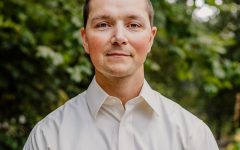
On May 21, Pacific Union College Professor of New Testament Ross Winkle was honored as the 2025-2026 Educator of the Year during a special Community program at the PUC Church. He was selected by the student body for his spirited teaching, dedicated mentorship, and commitment to faith.
Congratulations on being Educator of the Year! What does this recognition mean to you?
To me, being named Educator of the Year means that I am appreciated as a faculty member and educator by members in the PUC community. It puts me in the spotlight, which—as someone who is an introvert—I typically attempt to avoid if possible. But it is affirmation, and that community recognition provides motivation to do even better as I continue to teach.
What was your reaction when you heard your name called as Educator of the Year?
When I was announced as Educator of the Year, I was surprised and shocked. I did not think that I would ever get that recognition. There are many faculty members who deserve that award, and I thought that I would certainly be at the end of that line.
How do you stay motivated and passionate about teaching and being a mentor to your students?
I’ve noticed a rise in biblical literacy over the years I’ve taught, and so I have a concern to help students, from whatever background, to be able to either develop a foundation for understanding at least parts of the Bible or expand their understanding and appreciation of the Bible and its “grand narrative.” That provides ongoing motivation to assist students as they engage with Scripture within its contexts and live their lives within their contexts to the fullest.
But beyond that, being able to present academic papers at biblical studies conferences not only in the United States but in such countries as Austria, Belgium, Bulgaria, Italy, Poland, Scotland, Sweden, and Türkiye provides an additional motivation to integrate my research findings and what I learn from others into my courses and help make them more current in terms of the latest research and, I hope, more meaningful for students.
You have been teaching at PUC since 2005. How has your way of teaching theology evolved over the years?
I’m more flexible and less “programmed” than I was when I first started out. I had been an adjunct professor at Andrews University in Michigan during my doctoral program, and I taught the equivalent of about a year of courses during that time, but I wasn’t teaching full-time until I started here at PUC.
When I first started here at PUC, I didn’t know some subjects well enough and had to develop and carefully follow a well-developed outline of what I wanted my students to know. During my first year here, I was barely keeping one day ahead of my students in several of my courses. But after teaching many of the same courses over the years, I now “know” my course content much more than I did when I started out here, and that has contributed to more flexibility in my teaching, more time for questions and answers and discussion, and more time for “side trips” that develop as classes move along.
What do you enjoy the most about teaching your students at PUC?
I enjoy seeing students explore ideas and concepts in scripture that they haven’t seen before. I enjoy seeing students realize that there is more to life than what they experience on Earth, that the future is filled with hope for the return of Jesus, and that this hope provides them with meaning and purpose today. I enjoy discussing biblical and theological topics with students and seeing them grow spiritually from one course to the next and from one year to the next.
What are some of the most rewarding moments you’ve experienced as an educator at PUC?
Our Theology department’s annual retreats at Albion have been times when we can “get away” for a weekend, enjoy coastal nature, develop deeper relationships with students, and be spiritually revived. Another rewarding experience is when students ask about biblical and theological topics they’re grappling with, whether it’s on the way out of class or when they want to meet for some time and talk in my office. Seeing students reshape their thinking and understanding about God and Scripture has also been rewarding.
If you could have your students remember one core lesson from your years of teaching, what would it be?
Read and study scripture. It is worth one’s time, effort, and investment. It drops us into the “grand narrative” of life as active participants, and it lifts us above the events of life that can cause us so much stress, anxiety, and pain, and reveals a living Savior who can provide healing, rest from stress and anxiety, and the ability to live life—and live it more abundantly.
What is your favorite thing about being a part of PUC? What keeps you here?
I can think of two things in particular. First, one of my favorite things about being part of PUC is that our courses aren’t so large that I don’t even know the names of students by the end of the course. Smaller class sizes foster more mutual communication, discussion, and relationship-building. Second, another favorite thing is that I can be both a teacher and a researcher; I’m able to attend and participate in research communities at academic conventions here and in Europe regularly.
What inspired you to become a theology professor? Did you always know you wanted to take this career path?
When I was a junior in academy, I had a Bible teacher whom I liked personally and who taught our Bible doctrines course. But his way of teaching that course was to give us weekly lists of texts to memorize on various biblical topics. Students did not like that and were resistant to it. I decided that I could probably teach the course in a way that students would like better. That’s when I decided I wanted to be a religion teacher.
When I began as an undergraduate at Walla Walla College a couple of years later and asked what to take to teach religion, I was told there was no track for that and that I should take Theology, which was geared toward pastoral ministry. I also liked mathematics, and so I consequently started out as a Theology and Mathematics double major and an Honors student. I took a full year of Calculus before I decided that it would be too difficult to pursue both majors and Honors in four years, so I dropped mathematics to a minor and soon afterward dropped it entirely (occasionally I still dabble in recreational mathematics). Instead, I picked up Biblical Languages as my second major, since there was significant overlap with my Theology major, and taking it as a second major would not add much to my time in college. In the meantime, I decided I’d rather teach at the college level than at the academy level.
After spending a year in Tokyo as a student missionary teaching conversational English, graduating from Walla Walla College, working in a taskforce position as a chaplain at Portland Adventist Medical Center in Portland, Oregon, and being hired as a pastor by the Oregon Conference and sent off to Andrews University in Michigan to obtain my M.Div. degree, I pastored for about a dozen years in Oregon in three church districts. Then I decided that if I were ever to be a religion teacher, I needed to obtain a doctoral degree. So, I went off to Andrews University again and worked on my doctorate in New Testament Studies, with a focus on the book of Revelation. After being invited to teach at PUC, I completed my doctorate in 2012 after about seven years. So no, it wasn’t a straight route; it took time, but I’m glad I’m in the profession I’m in.
Looking back on your educational journey, do you have a mentor or theologian who shaped how you teach today?
I don’t have one mentor or theologian whom I can point to as shaping the way I teach; rather, I remember several who sparked ideas on how to be effective teachers, of which I’ll mention a few. Lucile Knapp, my Greek teacher for two years at Walla Walla College, taught me more about the importance and significance of Jesus than about Greek in her Greek courses; Jesus is more important than many things we talk about in class. Jon Dybdahl, who taught me Hebrew for two years at Walla Walla, also taught me that learning biblical languages can be a real eye-opener, even when one discovers disturbing items and issues. Chuck Scriven, who taught Systematic Theology at Walla Walla, taught me the importance of being faithful to the text and contexts of Scripture.
Abraham Terian, at the SDA Theological Seminary at Andrews, provided a living example of a quiet professor who could yet amaze students by revealing concepts in Scripture that we had inadvertently skipped over in our too hasty reading. Jacques Doukhan, also at the SDA Theological Seminary at Andrews, similarly showed how courses could be “what is he going to blow me away with today” courses. Robert Johnston, who was chair of the New Testament department at the seminary for a time, taught me to have high standards but also be generous with students. Jon Paulien, who was my doctoral advisor at the seminary, taught me to advocate for students, support them, and encourage them.
What advice do you have for students who want to apply theological ethics to their everyday careers?
I can think of many texts that provide a foundation for biblical ethics, but I’ll just mention a few. Work as if you were working for God, not just a human boss (Colossians 3:23). Be kind, promote fairness and justice, and be humble (Micah 6:8). Treat others as you would want them to treat you (Matthew 7:12). While applying and integrating these principles in one’s career and work environment won’t necessarily be an instantaneous panacea, they can be transformative, even if they might appear to be so only in small ways.
As Educator of the Year, how do you define the ultimate goal of theological education?
In my estimation, the goal of theological education is to know God, be changed into God’s image, integrate scripture into one’s life, and be an agent of spiritual change in others.